





Lafitenia: what we are doing, what we are correcting, what we stand for
Over the past few days, our project in Lafitenia has sparked strong reactions. We have heard them. They express concern, distrust, and sometimes anger. We are not dismissing them, but we also wish to express our perspective and correct a number of false allegations.

We also understand that a project of this nature, in such a sensitive location, cannot be understood if it is not explained clearly, nor accepted if it is not rooted in genuine dialogue with the local community.
That is the ground on which we now wish to stand: facts, clarity, coherence, and action.
We are not writing this text to fuel another controversy. We are writing it to explain what we are correcting, what we are concretely doing, and what we fundamentally stand for.
In this article, we are making available the complete presentation file of our revegetation and landscape approach project. We also exercise our right of reply on several subjects for which we would like to provide clarification.Dans cet article, nous vous mettons à disposition le dossier complet de présentation de notre projet en matière de végétalisation et d’approche paysagère. Puis nous exerçons notre droit de réponse sur un certain nombre de sujets sur lesquels nous souhaitons apporter des points de clarification.
1. Part of the situation was poorly experienced. We acknowledge it.
We are not trying to avoid the obvious: certain images, sequences, and perceptions created shock.
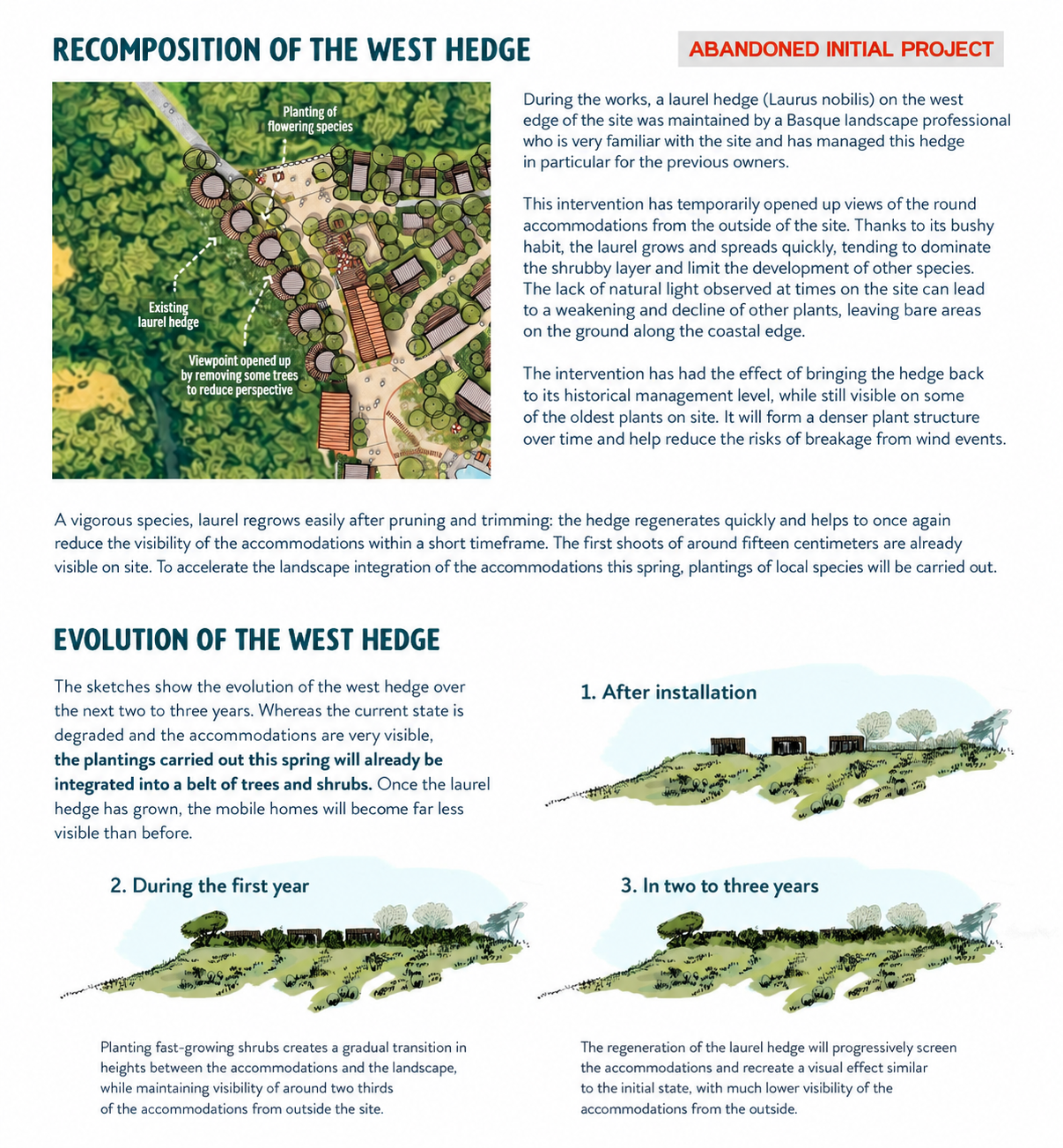
Regarding vegetation, we have already acknowledged one specific point: the pruning of the hedge above Lafitenia beach was too severe. We take responsibility for it. We have publicly acknowledged this mistake, and the first regrowth is already visible. Recognizing this does not weaken our project; on the contrary, it requires it to become more rigorous, clearer, and more exemplary. There was no deforestation, no clearing, and no uprooting.
It was simply maintenance carried out by a local company that has historically maintained this establishment. We have also understood that some of our public communications may have created misunderstandings. They are currently being revised to be more accurate, more restrained, and more respectful of local sensitivities.
2. We decided to remove the three round mobile homes.
We confirmed this to local associations and acted very quickly: the three round mobile homes were removed as soon as possible. This decision is consistent with what we heard locally.
It does not mean that we are giving up on thinking about, developing, and improving this site. It means that, faced with strong tensions, we chose to act, ease a major point of conflict, and demonstrate that we are not operating through force.
It is important to clarify that beyond the installation and construction phase, the development project for these camping plots was ultimately intended to provide more harmonious landscape integration, with a gradual reduction of the visual impact of the accommodations.
That being said, the lack of information about the project caused surprise and justified anger among part of the local population, with some feeling they were witnessing a clear visual degradation of a protected landscape.
3. This project does not aim to urbanize untouched natural land. It aims to transform an existing campsite.
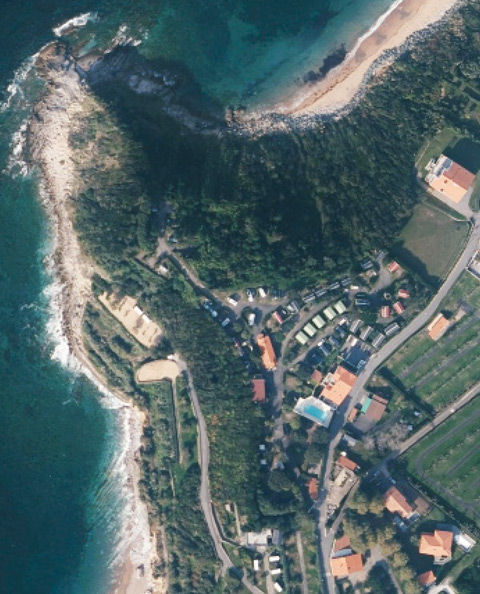
It is essential to recall a simple fact: the Lafitenia site is not a natural area upon which a tourism project is suddenly emerging. It is an existing campsite that has operated for more than fifty years, experiencing decades of tourism, successive developments, car circulation, and human pressure on its soils and ecosystems.
This is therefore a site already in use, already visited, already impacted. The question is not: “Should an untouched natural site be turned into a tourist destination?” but rather: “How can an old campsite already in place evolve in a more restrained, coherent, qualitative, and less impactful way?” That is precisely BonjourSauvage’s ambition in Lafitenia.
4. We are not destroying nature. We are initiating its regeneration.
We firmly and responsibly stand by this approach: our project does not aim to intensify pressure on the site, but to change the way it functions.
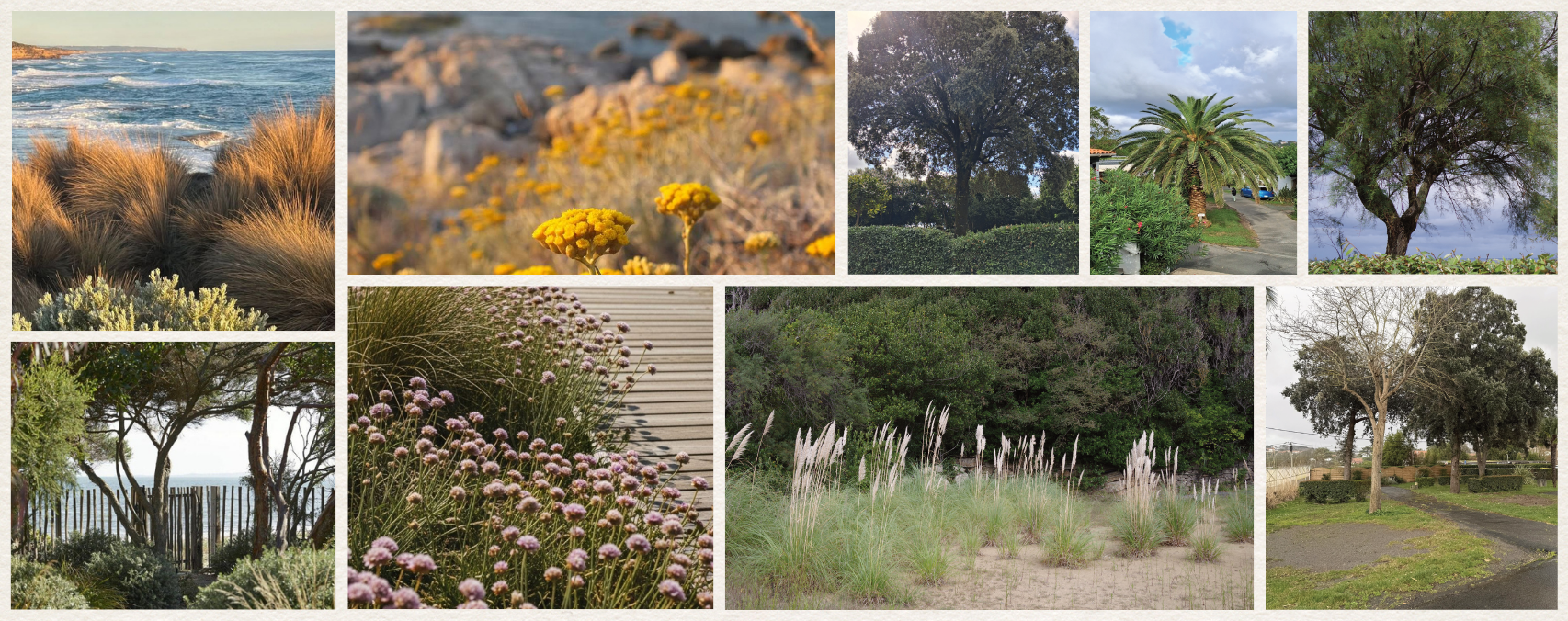
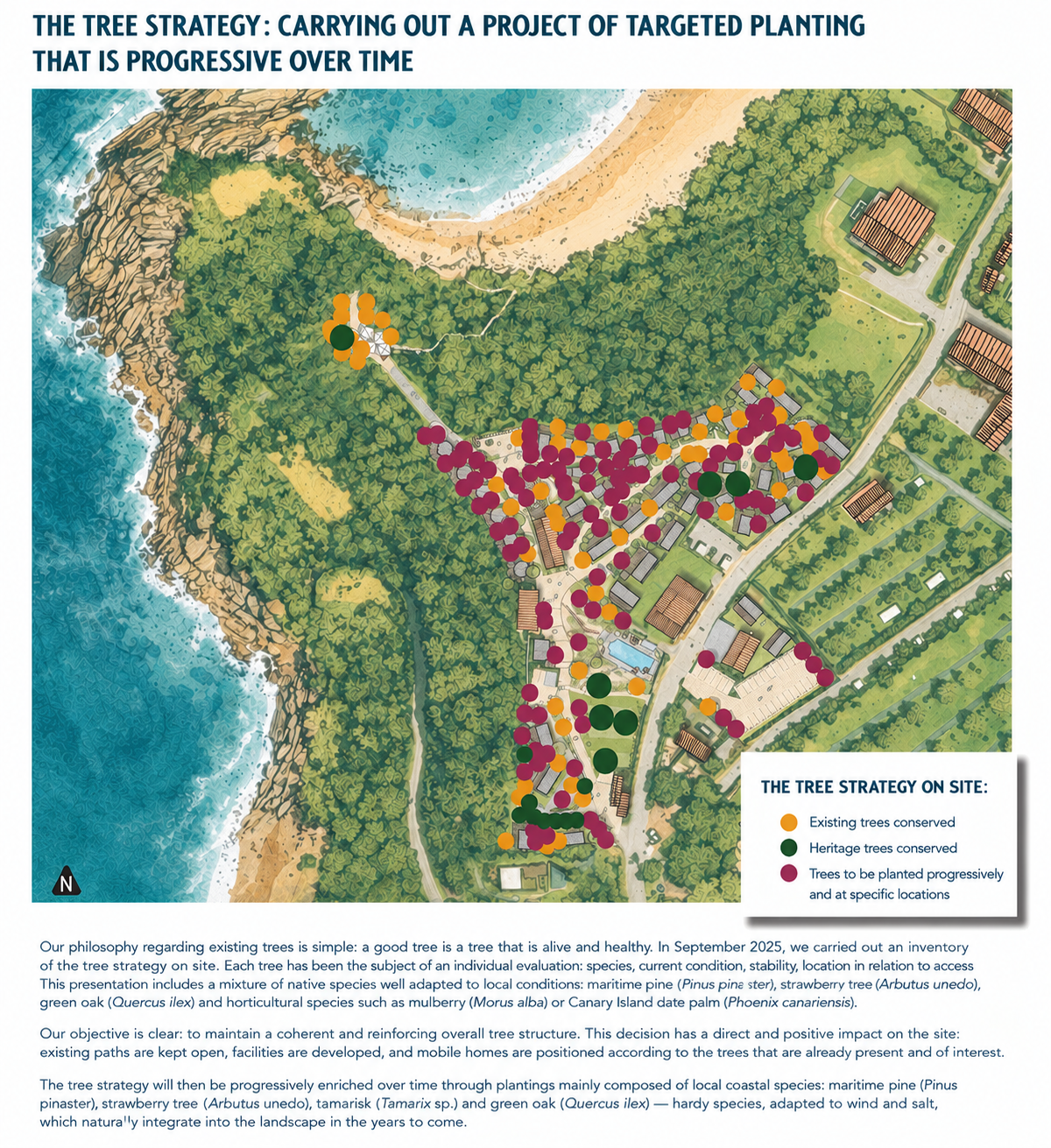
This begins with the replanting of endemic vegetation and landscape restoration work. It also involves pedestrianization, soft mobility solutions, and increased attention to local biodiversity. Finally, it includes more controlled management of uses and circulation.
A complete ecological inventory of the species present on the site was conducted beforehand. The landscape design was entrusted to a specialized firm with recognized expertise. A limited number of plants were removed only when they were diseased, dangerous, and identified as invasive exotic species. No remarkable or century-old tree was cut down on this site, contrary to claims made in a press article, which are simply false.
We know that in moments of strong emotion, theories can quickly replace facts. That is precisely why we must document more, show more, and explain more.
5. The cliff and coastal erosion are not secondary issues. They are central issues.
We have absolutely no economic, technical, or human interest in weakening the site on which our activity depends. That would be absurd. Coastal erosion and shoreline evolution are, on the contrary, among our primary concerns.
Geological studies were conducted. Discussions took place with the relevant stakeholders. The root systems within the cliff were not affected. There was no excavation work on the cliff, nor any cutting at root level.
We are not asking to be believed blindly. We are simply asking for facts to be examined for what they are, rather than through the lens of assumptions projected onto them.
6. The project reduces visitor pressure instead of increasing it.
This is a major point, and it has not been sufficiently highlighted until now.
At full capacity, the site will go from approximately 360 guests to around 200. This reduction is not insignificant. It reflects the philosophy of the project: lower density, less saturation, less pressure on the site, higher quality of use, greater control, longer stays, and above all, a design adapted to the vegetation and topography of the area.
In other words, we are not defending a volume-driven project. We are defending the transformation of an existing site into a more focused, demanding, and sustainable model.

7. On gentrification and local housing, real situations must be distinguished from simplistic shortcuts.
We hear concerns regarding gentrification and housing for local populations.
These are serious issues affecting many territories today. Denying them would be absurd. But situations must also be distinguished.
BonjourSauvage does not involve removing residential housing from the local market in order to convert it into seasonal rentals. The project is located on a site already dedicated to tourism accommodation, within a clearly identified and historically operated framework.
In that sense, the project does not contribute to reducing residential housing availability; it structures a tourism offering in a place where other forms of dispersed accommodation weigh much more heavily on the local housing market.
To be completely frank: a regulated tourism offer on a site intended for this use is often less problematic for local housing than the silent multiplication of short-term rentals scattered throughout residential neighborhoods. Our project directly competes with that seasonal rental market.
8. A tourism project can also generate local employment and territorial value.
Here again, we must move beyond caricatures. BonjourSauvage is not a passive real estate investment. It is a genuine operating activity. That means jobs, service providers, maintenance, purchasing, services, and a tangible economic presence within the territory.
At this stage, the project represents 17 people employed this season and ultimately aims to create around six permanent jobs. Of course, this alone will not solve all territorial balances. But it matters. And it contributes to a local economy that is not limited to property speculation or simple value extraction.
We also firmly believe that improving the quality of an offer is not, by nature, a mechanism of gentrification. A more qualitative offer can also mean better integration, greater sustainability, longer operating periods, better management, lower density, and greater usefulness to the local ecosystem.
Our accommodations were designed and assembled in France according to specifications written by the founding team.
The principle is simple: to offer “mobile” accommodation with the same level of quality as a hotel room.
For us, this means acoustic and thermal insulation comparable to residential housing, along with responsible material choices. That is how we define outdoor hospitality.
In our view, cream-colored plastic mobile homes with poor insulation do not meet the standards of sustainability and quality we wish to offer our guests.

9. BonjourSauvage was founded as a social and environmental mission-driven company.
At BonjourSauvage, we did not suddenly “decide” to become a mission-driven company. Rather, by structuring our approach, we realized that we had fundamentally been one from the beginning.
From the start, all the ingredients were there: a clear desire to do things differently. To offer hospitality that is more sincere, more respectful of places, people, and living ecosystems. A willingness to move beyond the sometimes rigid standards of outdoor hospitality and create places that have meaning both for those who stay there and for those who work there and contribute to them.
BonjourSauvage was born from a strong intuition: that a hospitality project can be desirable, demanding, and committed all at once. A project where customer experience does not come at the expense of the environment, and where economic performance does not oppose positive impact, but depends on it.
By taking the time to formalize our mission, we mainly became aware of the journey already accomplished. Many structural choices had already been made, often instinctively, but always guided by the same level of rigor. And above all, we realized how strongly this vision was already shared by the entire team and our partners.
But this exercise also confronted us with a simple reality: this is only the beginning. Building a mission-driven company is not about displaying intentions; it is about embracing a path. A demanding, sometimes slow path, made of trade-offs, priorities, and a certain form of humility. We are the first mission-driven outdoor hospitality brand. It is a source of pride, but above all, a responsibility.
10. We would now like to be judged on what comes next.
BonjourSauvage was not transformed into a mission-driven company. It was designed to be one. And now, it must prove it, day after day.The easiest thing would be to hide behind intentions. We will not do that. We prefer another path: publishing, explaining, correcting, showing, and documenting.
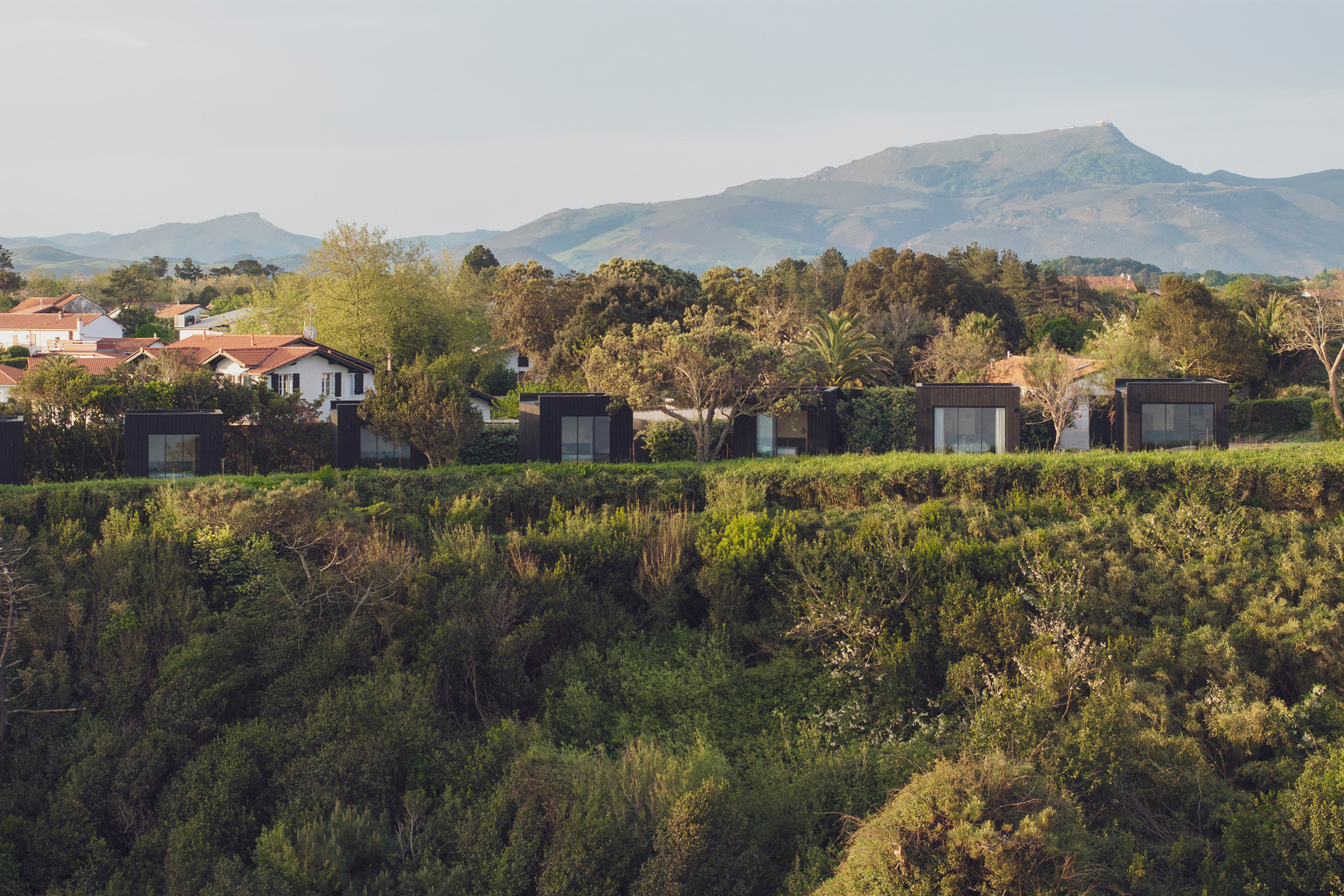
In the coming weeks, we will publicly report on the site’s evolution, the adjustments undertaken, the landscaping work, and the way this project continues to move toward lower density, better integration, and territorial responsibility.
We know that one text will not erase doubts or disagreements. But it can at least help place the debate where it belongs: on the ground of reality, commitments, and facts.
That is the ground on which we now wish to move forward.
The BonjourSauvage Team